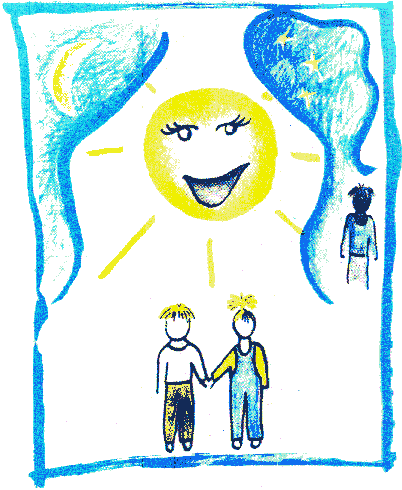
Experiences with racism in a Danish Steiner school
From the Danish podcast “Kaffe og Kaos”
My children are Danish/African, and they experienced quite a lot at the Steiner school, which we said a final goodbye to in 2022.
My daughter quickly became friends with another girl who looked like her. It became very clear early on that the two of them were not allowed to be best friends. There were all sorts of issues with them being so close, something that did not apply to the other girls in the class. The class teacher wanted to separate them and even invented conflicts. She told different things to us parents, and in the end it resulted in us parents falling out badly because the teacher was pulling different strings. She kept adding fuel to the fire.
When the girls reached 7th grade, they became best friends again and still are today as 20-year-olds. We have talked about it now that they are adults, and they never had any problems with each other—it was a conflict created by adults. It felt as though the two brown girls were not allowed to be friends. They had to be separated. Perhaps together they were seen as too strong (that is my personal impression).
Another experience was that the two brown girls were always given “villain” roles when they performed in plays. My daughter’s friend had to be “the witch” because, as the teacher said, she already had black, frizzy “witch hair.” My daughter had to be hidden away in a large costume, and another time she had to play a disgusting, dirty villain. Meanwhile, the children of the “favorite” parents were always cast as angels and similar roles, with their fine, light hair.
My daughter also experienced a teacher bringing chocolate-covered marshmallow treats (flødeboller), which the teacher referred to using a racist term (“n****r buns”), while getting the rest of the class to laugh about how that was probably not something you were allowed to say. On another occasion, the same teacher pulled at the corners of his eyes to imitate being Chinese.
My son experienced something in 1st grade during the COVID pandemic. He dropped his lunch on the floor (probably because he was extremely anxious about his class teacher). She forced him to eat the food. My son refused because there was sand on it (he is also highly sensitive) and he was afraid of COVID and bacteria. His teacher insisted that he eat the dirty food and told him that he should think about “the poor children in Africa.” This was extremely condescending, especially since he himself is half African. As a result, in the weeks afterward he had difficulty eating because he kept imagining sand and grit in his teeth.
There is a great deal of “hidden” racism, but also quite a lot that is expressed directly, for example by other children—and my children were not able to seek help from the adults who were supposed to support them. Fortunately, my children are thoughtful and well-guided from home, so they are able to recognize when comments are inappropriate.
The sad part is that every time I raised these issues, I was told that there were children from many different countries at the school—as if, for example, German and Norwegian children experienced the same thing.
Even though we said goodbye—not “see you again”—in 2022, the stories are still coming from both my children. Much of it has been suppressed, but it comes out in small pieces and has had significant consequences for their self-esteem and sense of self.
 Steinerkritisk Forum